
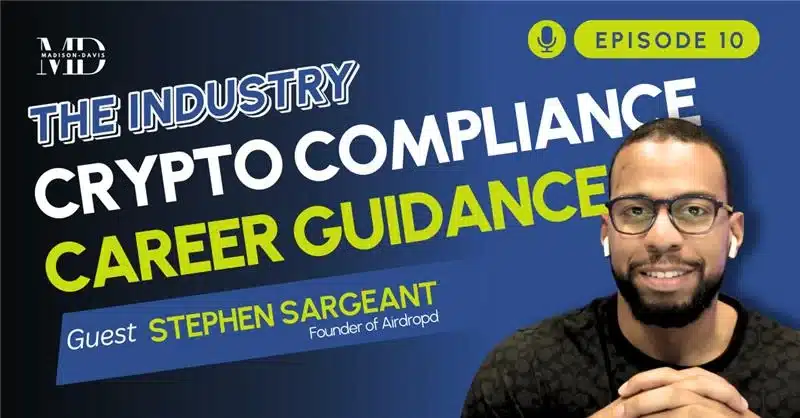
Episode Summary
In this episode of The Industry, Zachary Plotkin and Sanjeev Menon sit down with Steven Sargeant, crypto compliance expert and founder of AirDrop, for a wide-ranging conversation on career strategy, content creation, and the realities of working in crypto, fintech, and financial crime today.
The discussion cuts through surface-level advice and focuses on what actually moves careers forward — especially in competitive, fast-changing markets.
Transcript
SPEAKERS
Zachary Plotkin, Stephen Sargeant, Sanjeev Menon
Zachary Plotkin 00:06
Good afternoon, everybody, and welcome to another episode of the industry. What industry you say? The industry, the video series where we’re going to discuss the job market, give career guidance, market Intel and everything in between. My name is Zach Plotkin, joined by my co host, Sanjiv Menon from Madison Davis, and today, we are going to be interviewing the man the myth, the legend, Mr. Steven Sargent from AirDrop. So good to have you on, Steven, Steven, welcome and thank you for being on.
Stephen Sargeant 00:33
I appreciate you guys. I’m excited to have a conversation about everything, AI, jobs, career, FinTech, crypto, you name it. I’m here for
Sanjeev Menon 00:41
a long hopefully we can get it all in, man, so we’ve known each other for five years. We’ve seen each other evolve in our in our careers. You went from being a compliance practitioner to being so compliance expert, but using that expertise to create great content on LinkedIn, focus towards everything crypto, right? Career Guidance, the best tools, the best way to find a job
Zachary Plotkin 01:12
across the board, best people to network
Sanjeev Menon 01:14
with and networking, right? It’s, it’s every everything you could think of within the crypto space, right? Is that the best way to describe what you’re doing from content space, content creation?
Stephen Sargeant 01:27
Yeah, exactly like crypto compliance is my jam. That’s what I know the most of. And I found that once you get into crypto, there’s a lot of people that give a lot of advice, and a lot of that advice is geared towards their own incentives. So I try to lay it all out there, how to make money, things to avoid, how to find jobs, how to like, create your own brand, and just other people that you should be looking out for, highlighting and working with, so that they at least can have one trusted. You know, I still get paid for my clients, but I try to be as unbiased as possible. And when I do have a bias, I definitely let everyone know clearly that it’s biased information.
Sanjeev Menon 02:02
Yeah, so, I mean, that leads to my first question. And, you know, we prepped for this, for this recording. How do you create your content? Is it a method? Is it? Is it inspired? Is it combination of both?
Stephen Sargeant 02:21
I love that question? I take little things, everyday things. We all have probably 10 to 15 content ideas every single day, but then the first thing that cancels out 90% of them is like, Oh, we’re too scared to post it. And then the other 10% is like, ah, nobody’s going to care. And I just try to take anything that comes to me, this conversation is going to lead to some kind of content. I’m going to say something. I’m going to listen to you guys. I take things like your salary guide. I’m like, Oh, this is interesting. I take even conversations we have around hiring. I’m like, somebody would need to know this information. Let me add my own contextual opinions to it, and just other commentary from the industry, and just put it out there. As, my opinion, I think a lot of people get scared to put out content because they’re scared what they’re, you know, the person that they are, co workers are gonna say, or their boss is gonna say. And I think fear is the one of the reasons why people don’t put out most content. And I usually like to be inspired. Like, if you ask me, like, Steven, can you post about this podcast tomorrow, I would probably freeze up. But if you just let me naturally think of a cool idea and just kind of run with it and find other things within the ecosystem that I can put together two or three points together, and that’s how I do my content. That’s why, when people ask me, What’s your content schedule or your calendar looks like, I’m just like, I kind of just go with what I feel, and I just try to draw from the experience of talking with professionals and experts like yourself.
Zachary Plotkin 03:47
Well, I saw that. You know, your posts are always very active and very, very energetic. There are sometimes I’m curious, when you get an idea into your head, do you just like, hey, I got to run to the office network court right now, or is it more strategic and planned out.
Stephen Sargeant 04:02
I don’t sleep like, when I get the idea like, and you can see in some of the videos I do, it feels like, Oh my God. Like, you must say this all the time. I’ve been like, replaying the same thing in my head over and over again. And usually when, like, I can’t help it like, it almost feels like it’s frustrating not to get it out. I’ll just sit down. I’ll leave a note in my like, phone of like, hey, I want to talk about career or salaries or compensation, and then usually what happens, because that note is there, anytime I see something like, Oh, they’re offering a content creator a million dollars to create content for a CEO, I just kind of like, plug it into that post, where I have a couple notes already, and I usually build up over time. And that’s why a lot of my content will be very contextual and have a lot of tags and people in it, because I like, absorb a lot of information before I post, and I usually leverage a lot of information I’m getting from third parties or other experts.
Sanjeev Menon 04:52
Yeah, same, same here. So, like, I appreciate that last point. So one thing that I’ve been working with eight cams today. Me on is, instead of doing articles that are 1500 words that no one’s going to read because it’s behind a file, a paywall, right? I convinced Carla and the editorial team, hey, we need more traffic to the the at profile on LinkedIn, the tidbits with John, I can never pronounce his last name, sorry, John, strike whatever great guy you know I’m talking about. The one thing that I have an issue though, with is making sure I I’m a control freak, and I want every word to be perfect, right? And sometimes I’m scared to post certain things and then the relevance piece, right? Like, I don’t want to write a 1500 word article that’s take me two months, because in two months, it’s going to be irrelevant, right? So going back to your style, how much is the relevance piece? A part of it, meaning, like, I have to do this post right now because it’s going to be irrelevant tomorrow. And then how do you do it, right? And what I’m getting at is, for the people that are watching, how do they use social media to stay relevant, quick and without, like, too much. We don’t want people thinking too much, right? That’s, that’s the beauty of social media. Like, how do you do how do you do that?
Stephen Sargeant 06:27
I think just realizing, if I like Gary V talks about of his book here in the corner is like, one is greater than zero, if one person can find value out of something, I say that’s better than me not posting at all and nobody getting value. I think, you know, we work with like, several clients, top clients in industry, and they’re very particular about the brand and message they put out there. And that’s kind of why they like working with me, is because I can just post the way I want to. I’m not posting on their social media. I’m posting on my own social media. So I don’t have to have every word correctly. I would never take, in my opinion, two months to write anything, because I know as soon as I press publish, the message is no longer controlled by me. Anyway, I say a lot of things I can if I wrote a post tomorrow about how to make $500,000 in one year, there’s going to be half the audience that says, Oh, my God, I should take these tactics to help me in my own career make more money. And then half of those other people are going to say he’s egotistical. He’s, you know, all he cares about is money. We should be worried about making money and revenue and AML. It’s about the people and the ethics and the moral so it’s the same piece of content. It’s not I could write it in a certain way. I could write it on one way or the other, and somebody’s always going to either have a problem with it or find value with it. And you know, to the A cams today, it’s like they can still put things behind the paywall. I think there should still be an incentive to want to go and be a part of a wider community. It’s why I joined a cams, right when I first got into AML, is because I wanted to be part of a wider community. What I would be doing is like, hey, taking that article you read and doing three or four videos about the article, and then if people really want to see in depth about the article, they’ll go read it. I just read one the other day based on an email that, you know, I sent out, or one of the first posts I ever mentioned. Chain analysis was based on the A cams conference where Jonathan Levin, who’s now the CEO of chain analysis, did an event back in 2017 and I went back, and it was nice to be able to go read the article where that was mentioned for free. But I think putting out as much free content is always going to drive people back to your paid stuff because they don’t want to miss anything. I think we’re so concerned about keeping things behind the paywall for those reasons. But that doesn’t mean you can’t create a video or an image or a carousel and post about that article and want people to go read more.
Zachary Plotkin 08:48
So So Stephen you, you put out a lot of content related to crypto, related to blockchain, related to career guidance, related to compliance. How do you combine all those and like, which one do you tend to go lean toward more often than not? Or is there one or the other?
Stephen Sargeant 09:04
I tend to go with whatever my experience is. So like, I was a blockchain investigator for almost five years rolling the biggest crypto exchanges in the world, but also worked at a bank for a year and a half. And anyone that’s worked at the bank doesn’t he doesn’t need to stay there very long to see some of the tendencies and some of the information and how it’s processed there. So I tend to draw from my own experiences. So a lot of my career guidance is me being the hiring manager or working with hiring managers at bifinex, or being a recruiter, you know, on the side. So I’ve interviewed probably more people than people have done interviews. So I have a lot wider scope of like, Hey, these are the things we’re looking for. These were some deal breakers. This is why you’re not being considered. So I try to draw from my own experiences, and all my content is really based on my experiences. And, you know, information I’m gathering from other industry professionals. So I try not to make it like hey, you know, I’m offering a course on crypto compliance. So these are the four reasons you should take the course. I’m like, No. What’s interesting is, this person took the course and they were a victim of pig butchering, and they were able to figure out where their money went because they took the course and did the investigation themselves. I think, you know, it’s not so much the course. It’s like, cool things you could do for the course and do with the course that I think gets people’s attention. So I don’t tend to focus on anything in particular. We’re talking before we recorded, my wife did a piece of content six months ago. She’s starting up content again. So I posted about that and tried to put a spin on it, like, Who’s a better content creator? Me or my wife? I think that’s where a lot of people struggle in content creation. They’re not thinking about what’s in it for the person or the audience that they’re they’re worried about what’s in it. For me, where’s my likes, where’s my engagement, where’s my, you know, leads, where’s my, where’s my, where’s my business deals. They’re not like, How can something I learned benefit somebody else? So their content is very me focused, versus when I think about content, like, oh, what’s one thing that person in the audience wouldn’t know that if I share to them, they could implement really easily right now, or a different thought process they could have. Or, you know, the way they went through an interview, like, there’s something that they don’t know you as recruiters aren’t going to tell people like, Hey, you really screwed up on this. For the most part, you really screwed up on this, or the client didn’t really like your attitude. It’s hard to give that feedback, but I can give that feedback about a lot of people without targeting one person, where I think it’s hard for recruiters to and this is why I love that you guys are creating content like this is because you can provide context to all the interviewees that you’ve seen, versus like single layout John that like asked when this vacation is in the first two minutes of the interview, yeah, and you’re laughing because you know what’s happened, right? Am I not many, many times,
Sanjeev Menon 11:49
I mean, I’m I’m laughing because Zach and I, we are very direct with feedback. The negative feedback, ironically, is the best feedback, because that’s the best way to learn. But it does take a lot of time to get the guts to tell a candidate, hey, you know that. How about you don’t take off your shoes and put your socks on the on the table? I mean, that’s that happened once. But No, in all seriousness, like candidates come to us and say, Hey, I don’t want to hear the automated response. I want to hear exactly what I messed up so I could fix it and get better the next time, being the messenger is tough sometimes, but we have to practice doing that because it’s best for our candidates and they and they really appreciate it, right? So we are very honest with our with our candidates and I and if any, if any recruiters watching this, I highly recommend having those tough conversations with your candidates, if they’re coming from the if they’re coming from a good place, if it’s coming from a good place, do it, because it’ll make your relationship, you know, stronger, but you know, sorry, sorry, I know you asked this question, Zach, but getting back to your you know your your your point when it comes to the Career Guidance part of it, what’s most important to you to share, right? Because the last one of the last posts that you, that you did, should I just, I just commented on it, you know, last week. It wasn’t about DMing. It was about it. But in general, you give people advice on, hey, don’t just apply through LinkedIn. You know, get a little bit more resourceful, right? It’s, it’s, it’s that, it’s, it’s on tip of my tongue. But when it comes to the career guidance, stuff like, how do you how do you come up with these ideas? Because I feel like there’s a lot of research before you actually deliver the video or deliver the content.
Stephen Sargeant 13:52
I think for me, it’s actually fairly easy. I think you guys will see it too. Is people don’t want to work. People don’t want to work hard to get a job. They want a job easily. They think because they’ve been employed for a certain amount of time, that guarantees them a right to have a job just because they meet the requirements, or just because the company’s hiring, and they probably even come after you, well, where’s all your jobs? And you haven’t got me anything yet, people do not want to work. So I’m going to beat that drum in every single method angle that I can, starting with the open to work LinkedIn banner, it’s like, oh, you’re choosing an easy way instead of messaging people directly and saying, Hey, this is my situation. This is what I’ve been doing since I got laid off. You want the easy way. You want to post and hope that someone’s just going to magically give you a job. And even if that were to happen, and even if you find an employer, is like, I always look for open to work, people like I guarantee you that job, the compensation is going to be lower than market value, and you’ve just lost all leverage in every conversation because you’ve showed everyone you’re open to work, or because you’re easy applying on LinkedIn. So a lot of my career guidance is, stop blaming the market. Stop. Blaming recruiters, stop blaming companies, stop blaming ghost jobs, and start looking at yourself and seeing what are you not doing? How many hours are you spending prepping for an interview? I’m going to guarantee you it’s less than one. How much time are you prepping into putting in an application? And I’m not talking about filling out the application that the company site tells you to, I’m talking about reaching out to connections, reaching out to people that work there, asking intelligent questions, researching the industry, the company, doing the actual things that the requirements are, instead of just lying and saying, Yeah, I took this certificate and then when you get them on the call, yeah, yeah, I haven’t really started yet, or it wasn’t that certificate. So it’s like this huge game that candidates are playing, and then they turn around and they cry about the market, but they’re not putting in the level of time, resources, investments. Sometimes it’s going to take you money to go find a really great job, whether that’s taking courses, whether that’s investing in a video editor to create a really fun, engaging video for them, my biggest client, chain analysis, came about not because I applied for a social media job, it’s because I sent them a 20 minute video I spent over $500 getting it edited by somebody on Fiverr Upwork, showing them about a position that I created in my head that I thought they were missing me, telling an $8.9 billion company what I thought they were missing, or what was the missing puzzle piece? That is sometimes what it’s going to take to get the job, to get the opportunity. And I think what people are just so short sighted, and every conversation they’re having with people is selfish. How can you get me a job? How can you refer me? How can you like people aren’t taking a they’re not being accountable for their own job search. And I know you as recruiters see that the most, because they’re expecting you to do the work for them. They don’t realize you’re like steroids, you’re a supplement. But if you take steroids and don’t go work out at the gym, you’re not going to get any stronger. You’re not going to get any bigger or better physique. So you have to use that as a supplement. Hey, I’ve already done all these things so that recruiter can easily refer you to a job. And that’s really how I approach career guidance, and it’s something that nobody really wants to tell people, right? They want to say, like, you should be considered for a job, somebody should take a chance on you. And yeah, technically, that would be nice, but we don’t live in that world, so I’m telling them exactly what they probably don’t want to hear, and what they’re not willing to face is that you suck because you’re not putting in the work that it takes to get this job. That’s not a bad thing. There’s a lot of work I do not want to put in to work with certain companies or certain clients. That’s not a bad thing. But you have to at least look yourself in the mirror and realize like, Yeah, I’m not putting in the effort. So these are my results, and I think that actually helps a lot of people, because nobody’s telling that information. Everyone’s lightly, nobody’s going to say, hey, you sucked in the interview because you didn’t prep good discussion topics or questions to ask the interviewer. And when they asked you, is there any questions for us? All you said is, hey, like, you know, when do we get breaks? Or how long after I start? Can I take a vacation? And everyone laughs when they hear that, but I hear that in like 60% of interviewed like these are the real situations that happen, and then people are confused why they’re not the top candidates. So I’m making sure there’s no confusion for people. In my opinion, I could be wrong. I’m sure people get lots of jobs without following the advice I give, but for the 90% why they’re not getting jobs, it’s usually because of one of these factors I’m bringing up in my content.
Zachary Plotkin 18:25
So for from just a general comment perspective, any webinar or any speaking engagement or any article that Sanjeev and I have ever done, probably the biggest two keys that we push out is you have to put yourself out of your comfort zone and ask someone something, and you have to network, networking and putting yourself into a position of just talking to people, getting to know people, getting a job is a job. And, you know, Stephen, you said it perfectly that no one is going to give you anything in this life. You have to make sure you put yourself in a position where you can be heard. You know, differentiate yourself in some capacity, even if that just means reaching out and say, Hey, are you open to a conversation? Not, hey, I’m looking for a job. Not, Hey, see my banner, not hey, I applied to this job. You know, what makes you different than the 900 other people that applied? Why would I want to talk to you over someone else? Why would a hiring manager want to talk to you over someone else? You know, you have to think of a differentiator. The key, the key point that I talk to people a lot is mainly about their resumes. What on your resume tells me you’re interested in a topic if you don’t get to verbalize it, if you don’t get to talk to a person, if I only got to look at you on paper, why are you interested in a crypto job? If you have zero crypto experience, if you can’t answer that question in a basic perspective, then you’re not thinking hard enough or thinking creatively enough, and you know, they’re throwing it out to people being transparent and being blunt. People need to hear it.
Stephen Sargeant 19:47
And the reality is, they could do that. They can get those conversations by creating content. Like people reach out to me about jobs all the time because they see me out there on top of mine, just by creating content. That’s how I got my first job at Biff. The next was, all I talked about, was crypto and AML. It was interesting to me, and this was early on 2017 where the barrier to get into a crypto job was living in enthusiasm. Didn’t matter. My boss in 2018 put Peter work CCO of Biff Next, put out a LinkedIn Post who wants to work for Biff next, AML investigator, he got like, three replies, and then people are mad that now they want to get in the industry. There’s not opportunities, and there’s not all like these opportunities existed, but maybe the timing was off for you. And to your point, Zach, I think it’s like, yeah, people don’t want to hear it, but people also don’t want to take the advice. I’m sure you guys give advice all the time, and they’re just not going to take it. And this is what I love about this industry, to be quite honest, is crypto is very merit based. Someone could come in today, spend all night studying for weeks and months and years and bypass me in a matter of years. It’s not going to be because of their seniority or who they know. It’s like, hey, they just know more than me. They know effectively how to be creative or more technical than me, and they’re going to beat me. And I love that about the industry, and I love that about content creation. I see a lot of content creators come and go, but the people that consistently have put out content for the last three years are very minimal because they want something for them. So once they get the job, they stop creating content, right? Once they don’t see results, because all they’re doing is doing is putting out content saying they lost their job and that they know the exact percentage of people that got laid off, and this is why they need a job, because they have bills to pay, and they’re supporting their mom. And these are all, these are all legitimate reasons, but the reality is that nobody cares. And the fact is that you have to realize that a, nobody cares and B, that you lose a lot of leverage by putting yourself out in those type of situations. You can show how creative you’ve been since you lost your job, and have a better chance of getting a job than crying on LinkedIn that you lost it in the first place.
Zachary Plotkin 21:52
So so we talked about the exciting times of digital assets in 2017 when you were kind of just getting into it, and people, you know, you had three messages that Peter Warrick had.
Sanjeev Menon 22:02
Oh, gee, by the way, pick ups. Peter Warrick OG, yeah, yeah.
Stephen Sargeant 22:05
He’s the one that a camps today, like eight camps was on top of crypto man. He was writing articles in 2017 you guys are having events then too, yeah.
Zachary Plotkin 22:17
Well, let’s, let’s shift it to today. I mean, let’s look at the crypto market today. I mean, it’s down compared to where it was. Obviously we’re going through a little bit of a craziness. But in your opinion, what do you think it’s going to look like in 2026 first?
Stephen Sargeant 22:31
I just, I love chaos. So, you know, everyone looks at the chaos, oh, my god, the market’s up. The market’s down. The market’s good, the market’s bad. I’m like, the only time you get paid over above the amount of market value is during chaotic times when things are just going good or things are just going bad, you can kind of tell what kind of compensation you’re going to get. But when things are up and down, people are looking for different things. Everyone’s trying to find the angle. So I think for professionals listening to this podcast, is you have to be able to thrive in the chaos. You have to look forward to it. You have to enjoy it and realize, like, yeah, you’re gonna get beaten down a lot, but you might get some over index rewards too, just by continuing really playing the game where I think 2026 is going to be for like job for like a job specific. I think it’s still a cool opportunity. There’s so many different companies popping up every day, and a lot more traditional financial institutions are getting into the digital asset space. So you have a lot more opportunities to take your traditional skills and transition into digital assets and not even get into a crypto company. A lot of your banks, your payment companies, your fintechs, are going to get into crypto so you can actually stay in the job. You are learn a little bit about crypto and actually benefit from staying at an HSBC. That when I brought it up in 2018 they’re looking at me like I had four eyes or 17 eyes at the time, whereas now they’re working on supply chain. They they’re part of basels institutes, like you know, they’re doing all these things that you know 10 years ago, eight years ago, six years ago, seemed completely foreign to their, you know, executive team, in my opinion. And I think right now is the best time, because so many people get hyped when the market goes up that when the market goes down, they’re not still looking at the jobs anymore. They’re not on LinkedIn. The beauty of crypto is that you can go to any one of these companies websites, and I think about 75% of them do not have their jobs that are posted on the websites, posted on LinkedIn, because they don’t want to deal with the bots and the AI automation and the easy apply. So the fact that somebody’s actually researching them enough to go to the website, to check out their documents page to listen to their podcast, to go to their conferences, you have a huge advantage because you know that nobody else is really going to put in that work. And what I tell everybody is, write out what your dream job require. What I call requirements look like. What is your dream job look like? Do you want to travel? Do you want a certain compensation? And do you want to work with certain people? Do you want a certain opportunity to grow write them all out and then just find the companies that offer a good portion of those things? Not going to be everything is going to find a good portion of those things. The funniest thing, I think Sanjiv will find this funny, is like Peter work all the things on my dream job requirements, except for Peter Wark mentoring me. He that’s the only thing that was not in my job at Biff Next, he didn’t spend all day holding my hand, mentoring me, and it was the best thing that ever happened, because he just let me go out in the wild. He let me go to Interpol conferences when he couldn’t make it. He let me go to FinCEN exchange conversations at round tables when he couldn’t make it. The fact that he wasn’t mentoring me, and he kind of let me go out and try and fail and come back and learn was the best thing that ever happened. But if people don’t even have a list of things that they want in their job, all they’re going to do is accept the list that the jobs have for them and try to change their resume, try to change the way they approach a company, and you’re conforming to what a company wants versus you being what you want, and the companies will start coming to you. More importantly, it’ll be narrowed down. There’s only going to be about 1020, companies that are going to be in that list. Now it’s a lot easier to do research. Now it’s a lot easier to go on their website and learn their protocol. And now with chat GPT, you can get those lists made in five give me all the companies I do it for my company. Give me all the rank tech, crypto companies, payment tech companies that are in compliance. Bring me that list, and I can start messaging these companies and start seeing what their social media and their content strategy is. So there’s really no excuse for candidates now not to be able to stand out. In my opinion,
Sanjeev Menon 26:37
actually, I couldn’t agree more. I think from a business development standpoint, Zach and I have to figure out what our perfect client profile is, right? We have to write it out, right? It’s actually very simple, but we still write it out because we have to do our jobs deliberately and on purpose. And if you’re in the job market, you have to do the same exact thing. You can’t just apply to every single job and then just wish for the best. You have to figure out what you even if you don’t have a job, and you have to be practical and figure out how to pay the bills. Totally get that, but you have to write down what your perfect next employer profile is, and it’s simple. It doesn’t have to be a white paper. It’s just, hey, I want to work for a Bitcoin company or a crypto exchange or a traffic company. I want to do FIU work or operations or something else, right?
Zachary Plotkin 27:36
Like, I even take further back Sanji, where I would say, find out if you’re happy. You know that the way that you can do that people don’t always love doing this because it becomes real. Tell yourself, take money out of the equation. Do you like what you do every day?
Sanjeev Menon 27:51
All right? So this is where we get a little philosophical. Happiness is not something that you find outside your own head. You’re either happy or you’re not. You could choose to be happy and not and in any situation, right? Like, I think we’re all pursuing happiness. Happiness is awesome, right? I mean, if you have a job that makes you happy, that’s great, but what you have to figure out is, does it pay the bills? Does it fulfill me? Does it stimulate my brain? Is it something that’s again, my next job, if it also makes you happy, great. But again, philosophically speaking, you could be happy without a job and unemployed, right? Like happiness is something that comes and goes. I’m happy. I was happy yesterday. Sorry. I was not happy yesterday. Very happy speaking to Steven tomorrow. I’m glad to see your face again, Zach, and I might not be happy again, like happiness. I think that when it comes to the job search, you have to figure out you’ll be very, very methodical about exactly what you want to do next, even if you don’t have a job, especially if you do have a job right now,
Stephen Sargeant 28:57
if I could merge both your concepts, I think one thing that we forget to ask ourselves, especially I’m turning 45 in 2026 is, what do I want? We have not asked ourselves, probably that my age in decades, right? What do the kids want? What their kids need? What does my mom want? What is it every we’re just so what? When is the last time? And I think that takes the happiness and the like, hey, what do I need to survive? It’s like, what do I want? And nobody asks themselves what they want, and then they wonder why they’re getting so frustrated a in the job finding process. But more important than you guys are recruiters, like a lot of people are not even they only like their job, but hey, it paid $5,000 more, so they went to the bank down the street, and now they’re unhappy, right? Because they didn’t ask themselves what they wanted, they just saw more money. And I think when you start focusing, I think it’s not so much about writing it down. It’s like you’re focused now. So when you see those applications and the jobs for a traditional bank, you’re not even looking at that, because that’s not what’s on your list. You want to work for a crypto company, and. I think where a lot of people struggle is they kind of just go back and forth with the trends. They just kind of go back and forth with what they think is going to make the most amount of money, instead of just asking themselves what they want. Because if you can answer the question what they want, and you can find what you want, I think money starts to be an A non, a non. It’s a non. It’s just a not a deal breaker, because you’re doing what you want, and the fact that I get to make content all day, that’s what I was doing all day anyway. I also get paid for it, and I get to make content all day. I’m in the content, and I get paid by clients to do the content. But I never started out with, like, how can I make money? Because content creation will be the last place I went to if I wanted to make money. There’s so many ways that are easier to making money, including, like, selling my feet pictures online, like that, seems like a lot easier way to make money. So I think if you figure out what you want, everything else can flow from No,
Sanjeev Menon 30:48
I totally agree. I think that’s that’s a sentiment that we all have, and we all help that different, like, philosophies on how that looks when it comes to the details, I have a different look than you do, then, you know, than Zach, but I write things down. I have a memory of a goldfish, so I write things down and I have a plan. Zach is the same way. He might not write things down. You might not write things down, but I think what we’re all saying collectively is Don’t wing it. Figure out what you want, and then go after it, and then what you deliver, though, getting back to the content thing, before we get to what’s going on in the crypto and Bitcoin space, the reason why I love your career guidance posts is because sometimes it’s it’s tough love. It’s just like, stop applying. DM, get resourceful. You know, go the extra mile. Figure out who the hiring manager is, skip all that noise, and if you want that job, go after it right, which I actually really, really appreciate, and me and Zach in our personal conversations or direct conversations with our candidates, say the same exact thing, but you say it in public. And I really appreciate that.
Stephen Sargeant 32:08
I try not to make it about tough love, to be quite honest. I just try to make it like, Hey, if you’re doing the things that I’m saying, you’re doing it I’m making fun of those things. Like, I might not be right, but if you’re doing all of those things and you’re still not seeing results. Wouldn’t it be better to try a different approach? That’s all I’m really trying to break through to people so and then I’m actually inviting I want people to debate me. If you think the green banner works, if you think that open to work, Banner works, and you’ve gotten so many great jobs when you see that, I want you in my comments. I want you saying, Steven, you’re wrong. This is how, because then you can teach them like, I don’t have to perfect. You can teach me how to teach them how to get the job with the green banner. But what I’ve noticed, and why I put it out there so much, is that there’s not a lot of comments saying, Steven, you’re wrong, or Steven, I have the opposite experience. And then if you do have the opposite experience, I can kind of break down why that is. I know why certain recruiters and companies are looking for that open to work banner, it has less to do with their morality and their willingness to take a chance on people is because they want to pay them 25% less than the market value of that position. So I’m okay having that debate too, and as long as they’re okay with confirming that which they which they never like to do, I’m okay with being wrong, but I want you to explain where I’m wrong, and what I’ve realized is it may not be the delivery that they like, and I think that’s where you’re getting into the tough love they may not like the delivery, but the message is pretty consistent. And before I make those posts, I’m talking to like, a lot of professionals, like, Am I missing something here? Like, am I wrong here? Like, I’ll talk to you guys about recruiting, like, am I getting something wrong? Do I not see the same thing you’re seeing? Or is it true that, like, half of these applicants are, like, bringing their parents to jobs, or they’re not even filling out the application properly because they just refuse to read or follow directions. And I get a little bit input before I make these bold statements as well.
Sanjeev Menon 33:59
Well, that’s good. Yeah, you’re getting second opinions before. I just like dropping, dropping the posts. I appreciate that.
Zachary Plotkin 34:06
Well, look, you know, you’re emotional and you’re passionate. That’s, that’s something that’s, that’s desirable. But, I mean, we can talk about those types of individuals who are now applying, who aren’t necessarily getting to where they want to get, you know, and those young individuals who how they’re going to be entering the market, I mean, and how all these jobs people are talking about how AI is affecting them, and how AI is going to be coming into the market. And, you know, Sanjeev and I here at Madison Davis, we put together a salary guide that, you know, is being pushed out over the next couple weeks, and we talk about in that guide how AI is here. It doesn’t need to affect your job, but AI is here, and the ideas about upskilling, you know, from your opinion, Steve and how do you think, from an AI perspective, it’s going to affect, you know, hiring across the board in the digital asset space or just general compliance, I think it’s
Stephen Sargeant 34:57
tough, because a lot of these tech and crypto companies are just like. You can leverage one person and they can, they say, like revenue per employees? Like something I’ve never heard before that. I’m hearing a lot now. How much revenue does one employee bring in based on how many employees you have? And that number seems to be going up in Tech because they’re leveraging AI. They’re leveraging those solutions. Me, personally, this is why I honestly think you should be leveraging AI every chance you get, and then to make to do the repetitive and the easy work faster, so that you can spend more time personalizing. This is just for, like, content wise, or networking or reaching out to people. So you can personalize all of that other things that’s customer facing or audience facing, and you can spend more time personalizing that, I think, where people are going reverse, they’re trying to automate and use AI to erase the personalization, to erase the things that they would normally do themselves, and that’s where they’re getting it wrong without doing it. I can use AI and make AI people, and I don’t think people would get upset. Or if Zach just started making content and only used AI, people will be ignoring that where, like, I’ve invested a lot in my content, where people are like, Okay, if he uses AI, that’s fine. Like, we know who he is. We see how much work he’s put in. And I think that’s what people are. I see it every day on LinkedIn. These sales professionals are going to be in trouble, because anyone can run an automated campaign, and you can take my last podcast and use it in the message like, hey, saw your last podcast. We have a person that would be perfect. Like, I can see the AI messages from a mile away. I can see the AI comments from a mile away, but that doesn’t make you a thought leader. That doesn’t make you a better candidate, because you can go on some AI platform that can apply for 100 jobs instead of four, because now you’re just can get rejected from 100 jobs versus I’d rather just apply it to four jobs and do a really great job of that. And I think AI is going to people are trying to outsource AI to the things that they’ve never done. And I think that’s where we’re going to get you’re going to get yourself in trouble as a candidate or as even if you’re an employee, if you’re just kind of sitting around pressing buttons all day, and you’re not really adding any value, or thinking about how your company makes revenue and how you’re adding to that or reducing the amount of revenue they’re losing due to fraud or, you know, anti money laundering concerns. If you’re not continuously learning what these AI tools are and how they can be implemented, I think you’re in trouble. I’ve seen a lot of people trying to use AI for like investigation, like STRS and SARS, I’m just like, Yeah, that’s fine if you’ve written a really good star, and you know what a really good star looks like, and you can modify that star if you’ve never written SARS and you’re just using AI, I think you’re gonna run into trouble because you’re not as valuable as someone that’s ridden a really good star knows what a really good star looks like and knows how To get AI to give them 75% of the star and them going adding in 25% of their genius to it.
Sanjeev Menon 37:46
Yeah, they’re by doing that. They’re almost working their way out of a job. Did they’re just using, if they’re using AI solely, and they can’t write on their own, you know? Like, I think that was a really good point. It’s a really good point.
Stephen Sargeant 37:59
And I think we’re far away from regulators just accepting AI like, and they’re going to be like, accepting AI STRS and all that stuff, but we’re a long way from regulators just accepting AI narratives, conversations, things like that. I think the human still needs to do the critical thinking for right now.
Sanjeev Menon 38:18
Yeah, no. What I meant is someone maybe using a prompt to create the narrative instead of writing the narrative first. Then maybe using, you know, AI to clean it up a little bit, or Grammarly to clean it up a little bit. I use Grammarly all the time for my emails, right? Like, I think I’m a very good writer. I mean, I’ve been writing Grammarly has proved me wrong with every single email that I’ve, I’ve written over the last, like, you know, six months, but it’s, like, super helpful, right? I missed a comma here. You know, I forget a word. I forget a word there. Like, that’s, that’s really important, but we still have the writing, being able to write. It’s still a very, very important skill that maybe AI will replace. But at this point in time, it’s still like a very important skill that you still have to develop. You can’t depend on, you know, any AI tool claw through, you know, chat GBT, to actually write a narrative for you based on a prompt. That’s what you were saying.
Stephen Sargeant 39:14
Was anything interesting that stuff for you from the Salary Guide? I want to add a couple comments, but I’m going to with it. It was anything? It was like, just incremental growth. Was it incremental decline? In your opinion, from like, who’s listening to this episode? Compliance officers, AML, investigators, I’m assuming is there?
Sanjeev Menon 39:30
I loved this year’s salary guide, because last year’s salary guide was, hey, AI’s here. That’s old news. RTO, you have to go back to the office. The new the new remote is, you know, the new local. The new remote is local, right? Like, I love this year’s content, because AI is here you have to engage it, but employ. It’s, it’s, it’s, it’s directed towards employers, saying, Hey, if you want to attract talent and keep them, not only do you have to pay more. Market value. But you also have to upskill them on your time, not on their time, on their personnel. You have to upskill them on the AI tools, or any tech tools that you’re using to make them more valuable at their job and pay them at the same time. And I don’t think I couldn’t agree more. So you’re embracing AI as a tool, because all companies are, you’re embracing the importance of humans in general to get any job done. But if you want the best of both worlds, make sure that the people that you employ know how to use AI tools, because they’ll stay retention is the enemy of any of any of any of any company, especially if you want to be best people, not retaining people is the enemy. That’s what I meant to say.
Zachary Plotkin 40:48
We’ve already seen it on a pretty consistent basis, from banks, fintechs, sponsor banks, crypto companies, where these organizations, they are. You hear the word efficiency quite a bit, and you want to leverage AI to create efficiencies in any way possible, with no other direction than that. And if you’re going to actually do that, you need to invest more in your people to make AI work with you, not against you. And I don’t think organizations are ready for that, just like not necessarily all candidates are ready to upskill mentally. So it’s like a very interesting place. It’s a very interesting read from the content perspective. And you know, I think we’re, we’re both very happy about how it turned out.
Stephen Sargeant 41:31
The RTO like the returning to the office would absolutely cripple me, and that’s kind of what I love about it, too. Because if you live in the jurisdiction, you have a now, you have a you have an advantage, right? If you’re willing to go into the office, you’re gonna beat out. 70% of candidates are like, Nah, man, I’m convenient. I’m dropping my dog to the vet during the day. I’m getting my groceries done Friday afternoon. So I love the fact that there is that competitive advantage for people that want to sacrifice something. I don’t want to sacrifice it, but I’m glad that there’s that ability. I love anything that causes there to be friction for other candidates. This is why I’m like certifications. Nobody wants to do the A cams. I’ll get my employer to pay for it. When I get a job like Nabi, I’m going to get my A cams now so I can get rid of 60% of the other candidates. I don’t have it show my employer that I’m willing to spend my own money to educate myself and put myself in a position that I can now connect with and network. That’s how I got into this industry. I just messaged 500 people that had the A cams and asked them what they liked about it. How did how was it for them? How did they find it useful in their career? And it was a starting point for me to start off a conversation. So I love any friction where I think people get caught is they don’t want to inconvenience themselves, they don’t want to Sacra like, you see the jobs where people are crying about not having a job, and then they say, I’m available to work in this city during this time between this and this month, because I have a b and c reason. It’s like, oh yeah, you don’t really want to work. And I’m not completely shocked as to why you don’t have a job. Also, I love your point about what clients and companies have to now consider there’s no such thing as the unicorns these companies are looking for at the price point that they’re looking for. And I know you guys have to have that conversation with clients. It’s the same conversation when I was a recruiter I had to have with clients. Is like, what you’re looking for does not exist at your budget. And if it did, it won’t be the what you’re looking for, right? You can either have good, fast or cheap. You can’t have all three of those things. You have to pick two. And every time you pick those two, the other ones are going to be a bail. So you might be able to have good and fast, but it’s not going to be cheap. And I think these companies are like holding out for these unicorn I see it so much in marketing, they want somebody to do ads, they want content, they want someone to run the email like that’s like a five person job, maybe three person if you leverage AI, but it’s definitely not one person, and it’s not going to be the one person at your price point. Same thing with Blockchain investigators. They want these people to be able to do everything, plus bring in business and biz dev, plus be able to train other like professionals, to get up to that like that’s just not going to exist at the $85,000 that you’ve allocated in your budget. So I think companies need to start getting more realistic. But it always seems that companies have the it’s always a it’s always a buyer’s market for companies. It seems like it’s never a seller’s market where candidates can kind of pick or choose. Companies always have the advantage, and that’s why they always put out these kind of ridiculous job descriptions and the salary expectations is because they can afford to hold out for it. A lot of these companies, I don’t think are really even looking I think they just like to have jobs posting to look like they’re hiring, because they don’t really seem that they’re serious. But you guys seen it, they come to you, they bother you, spend four hours of your time creating a job description, and then they see one post by like Elon Musk, and now they don’t want to hire anymore, because AI is going to take everyone’s jobs anyway. And now they hired an AI consultant that’s going to get them 15 people’s job product. Activity in the same amount that it would cost them to hire one person. So I think we see it from all angles. Yeah.
Sanjeev Menon 45:06
I mean, just to push back a little bit, it’s definitely a buyer’s market at this point in time, right? I mean, over the last, like, what 11 months, you know, the last 11 months, this whole year has just been strange with what’s especially in the States, with what’s going on from a federal level, it’s turned the market into a buyer’s market. You know, a lot of people were dosed, right? Which means that everyone in the DC, Maryland, you know, Virginia area, there’s a, you know, there, there’s a a lot of people that are really, really good, talented people that are looking right now, that are competing for the same, this, the same job, right? Which makes it easier for, you know, you know, companies to, you know, pick and choose, cherry pick, buyers market. And also, that’s a reason why, you know, there’s a little bit of a salary compression, right? In a lot of areas of financial services. The one area where there isn’t a salary compression the exact opposite. It’s, it’s the, it’s the blockchain space, it’s the, it’s the compliance and financial crime space within, you know, within crypto and blockchain, it’s the exact opposite, right? Like Zach and I, we have been but more now than ever have been working. Are working on these tracing jobs, right? It’s the equivalent of being a tml analyst at a tradfi company, right? But understanding how to use TRM and analysis and elliptic, those jobs. My God, it’s like you could have six months of experience you are and 24 years old, like you are gonna have a lot of beer, beer money. And put it that way, if you’re, you know. So, like, that’s like the one space where, like, we’re just seeing, even with the and we’ll get to the bellwether thing, personal, yeah, that’s the one area in compliance where we’re actually seeing the opposite of salary compression. Sorry to say, everyone we are seeing salary compressions in other areas of compliance and AML, especially in the States, just because of what’s going on at the macro and federal level. But even with Bitcoin dropping, you know, almost 66 33% over the last month, two months. It’s still a very hot area when it comes to financial crimes and investigations and salaries.
Stephen Sargeant 47:32
The reason why is because, you know, before, if you were in the US, you’re a liability to a lot of the bigger exchanges around the world, they didn’t want anyone to have people that were in the US so essentially, other than, like the coin basis, obviously, and other companies, but they only have so many investigators. But if you were looking at binance or BitFinex or other places, they didn’t want us professionals, because then that ties you into their US regulatory system, which was, you know, obviously not that they were trying to avoid anything, but we saw how ugly the US regulatory system was for digital assets until the last year. So now it’s like, you have all these trained up professionals, but they’re living all around the world, and now it’s the US people that you have to now train up, because essentially, the ones that have jobs have been there for a long period of time, and now that there’s so many entrances to the market, there’s just now blockchain investigators that have, as you said, more than six months experience. Because for the last, you know, until the last six months, there wasn’t a really need for them. There wasn’t a market for them. So you know, as someone that does train blockchain investigators, our last two sessions, like, like, completely dwarfed our like. Whole of last year, we’ve had 80 people in the last two sessions like, and normally we’d have about 20 people, 15 to 20 people, and a lot of those are from the US. So it just goes to show how much interest there is to get into a job.
Sanjeev Menon 48:57
Now I feel like you’re going to be a you’re going to be a regular on, you know, on the industry. No, no joke. I mean, like, you know, we run, we run, kind of running the same circles, right? You know, career gate, career content, career guidance, are definitely going to be on the show multiple times. But to sum up this first episode together, let’s go back to, you know, the original topic of conversation, which is a lot of people are worried about their job. They’re worried about their ability to network, right? I mean, like they don’t know how to do it. How would you in a couple of minutes, just provide the best advice you possibly can in using social media to help them find their next job, whether they have a job or they’re currently on the job market.
Stephen Sargeant 49:46
I think, you know, I did a webinar presentation about this, you know, it’s funny. I don’t know if you know Susan from tcae. They created, you know, a huge entertainment, and it was based on the concept from this webinar. Susan was in my class, and what I taught people was. Look for opportunities. Stop looking for jobs. That was, I think that was actually the title, stop looking for jobs. Look for opportunities. Because your mindset changes when you’re like, Oh, this is a cool opportunity. Oh, I can volunteer at Operation Shamrock. Oh, I can volunteer at the Association for Women in crypto and help them with their webinars, and help them with, you know, getting trained, the trainer and becoming a trainer. There’s so many opportunities out there that might not seem like there’s a lot of compensation tied to it now that will lead to more compensation than you know what to do with. The problem is, everyone’s only looking for jobs. So when they’re on LinkedIn, they go to the Jobs tab. They look for four minutes because it’s the same four jobs that were there over the last year, usually, and then they’re out. They’re bouncing. They might do a post here, and they’re crying about them not having a job. They might, you know, send a couple DMS to people that they think can get them a job, but then they’re out. So I think if I’m going to network, my goal on networking is a stop looking for jobs. Just look for cool opportunities. People that have time to do cool opportunities are usually employed or receive compensation. So if you’re working with people that are already employed have cool opportunities, they’re going to introduce you to other people, and if you can show those people in those opportunities how good you are, how reliable you are, how much you actually execute and care and how much value add there are going to put you in every single opportunity and job that you can name. And to your point, the reason why I Sanjeev and the reason why you see a lot of openings for blockchain is because usually it doesn’t even get to a recruiter. No offense to you guys, but a lot of them is going to be word of mouth, like, Hey, do you know a blockchain Hey, you’re good. Do you know any friends that are good? This is traditional too. Like, the first place you’re going to try is the people that are already good on your team and have a certain standard of excellence. Are you going to ask, Do you guys know anybody that has a job, or that’s looking for a job, or that doesn’t really like where they work and want to come over here? Like, that’s the first place that happens by the time it gets to like LinkedIn, like your, as the kids would say, You’re cooked. By the time it gets to LinkedIn, that jobs cooked. And you’ll see it by the 1000s of applications for people that live everywhere but the place where they need them to work are going to be applying for that job. And I think that’s the hardest part. Is everyone’s looking for jobs so they’re not seeing all these awesome opportunities that I see on LinkedIn every day. Then people are confused, like, how do you get all these Well, I’m just talking to the people that have all these cool opportunities. And the reality is, if you just listen, people can actually go on to this podcast and listen to what we said, and they would be like, Oh, I know exactly how I can get a job. I know exactly what opportunities to present. But they’re not listening. They’re listening for you to say, hey, Madison, Madison has this job. Madison Davis has this job and this availability, and come on this podcast and listen, and you can email us at you know Sanjiv, like, that’s what they’re listening for. So they miss all the expertise they missed when Aries on the episode talking about how the network they missed the opportunities to read your article where you probably lay out exactly the best ways to get a job in the industry, they’re missing all of it because they’re looking for the job. So they’re missing all the opportunities to actually get a good job.
Zachary Plotkin 53:16
Stephen, thank you again for all the stuff you have if you do if you don’t already, please go follow Stephen on all of his social medias, but specifically on LinkedIn. And please go. You know, if you’re a company that’s looking for marketing techniques or just helping help with your marketing from a compliance and digital asset perspective, please reach out to him. Go to airdrop, check out their website, and anything else that we could do to provide help for you. Please reach out to us, or reach out to Steven. So again, thank you for your time today, man,
Stephen Sargeant 53:43
I’m grateful for you guys, because, like, I’ve been yelling and screaming for recruiters to put out more content. You guys have all the keys. I only know certain things I’m not in these conversations every day. There’s some things are timeless, right? Like not having a good resume, not being prepared for your interview, but by having these interviews and talking about all these aspects. No recruiters do that because they’re too busy trying to find clients. And then when they’re not busy, they’re complaining about how bad the markets is. And I think the fact that you guys are busy and still taking time to put out quality content is going to be so important. Sanjiv, me and you had the conversation at the start of the pandemic where people are still like, reaching out to me like, oh, you know, I listened to that. That helped me. Because, like, just putting out content and trying to add value is never a bad strategy, and I wish more recruiters do it. I understand why they can’t and why they like similar to why people don’t like to put out personal content. You guys don’t want to step on any of the toes of your clients, either. And I get that, and that’s why I love putting out contacts. I’m not really scared. What’s the worst you’re gonna do? Cry to chain analysis, because I said that you should remove your open to work banner, like I’m okay with it if I lose a client, because I’m telling what I believe is the truth. I’m okay with that. So I love the fact that you guys are bringing on experts and being experts yourself. And that salary guide people should not I think people go there to read it for the salary, but there’s a ton. The content in there that’s going to help you improve your salary. If you just read, read this, read the guide, but also read in between the lines. I think if they can read in between the lines of some of the things that you guys are saying there, of like, Hey, this is where the industry is going. You need to catch it there. And the reason why I love AI and crypto is because, let’s just say Sanjeev has 30 years of experience doing AML and I just started out tomorrow. Well, we’re both on the same playing field when it comes to AI AML investigations. You might be able to leverage some of that 30 years of experience, obviously, to have a more robust view of how that’s applied. But essentially, if I learn about AI investigations, and you learn about investigations, we’re starting on the same timeline. And I think that’s what those newcomers to this space should stop worrying about, like, how to get that traditional experience and like, what’s coming next? Is there any way I can, like, catch that’s what I did. I went into crypto. I’m like, oh, nobody’s talking about crypto. AML. Let me start there. And I was, like, able to bypass a lot of people. And then what happens is those people with 30 years experience also see that the times are turning and they want to network and work with you to either publish articles and stay to your point said, you stay relevant, so you actually get to leverage that experience on your side without having to get 30 years of actual experience. And I think that’s a key thing that a lot a lot of people think about when they’re entering an industry like,
Sanjeev Menon 56:20
well, that’s definition of wisdom, right? That’s why we read books, right? We learn from other people’s mistakes, right? That’s, that’s, that’s the whole point. So, I mean, we love doing videos like this, because we’re, you know, we care about the space. We care about the people that are watching. We care about the people that we speak to every day. We We love the AML fraud fighters, a Financial Crimes community like, so we are taking time out of our day from doing business development, because this matters to us, right? This matters us. But let’s, let’s be real. The second that we get off with you, like, we’re going to be scrambling to make business effect, you know, sales calls for the rest of the day. So, but that’s, that’s, but hey, that’s the, that’s the whole, that’s the whole point, right? Like, find the balance. Find what’s important. Keep it simple. Keep it simple. There’s two things we got to do today. We got to speak to Steven, then we got to pick up more clients. That’s it, right? I went to my kids. I went to my first parent teacher conference today, right? Parent teacher conference, speak to Steven. Sales all day. Simple. Nothing else matters, right? You have to figure out what’s most important right to sum to sum this up before we close out. Thank you, Steven for being on. I think the most important points that I want, we want people to, you know, take away from this is, from a career guidance standpoint, is be resourceful when it comes to your search. Yeah, you could, you could press that, you know, quick Apply button. Maybe that’s a kitchen sink. Move, maybe it’s a Hail Mary. Move, do everything you possibly can beforehand, before pressing that button, you call, you call your trusted recruiter up. You look up advice from Steven Sargent. You figure out who the hiring manager is, and you reach out to them. You figure out if you have a former colleague that works at x bank, and you see if, yeah, they can put a good word, be as resourceful as you possibly can before you press that button, you’ve no idea where your resume is going, right. Like, and
Stephen Sargeant 58:12
when they ask for one thing, one up them. So if they ask you to put a resume like, deliver more, send them a link to a video that you’ve created about why you think you’re perfect for a job if they tell you to send a video link, like, create a production around, like, there’s always room to add in something extra, like, somewhere in the application process that most people won’t do, especially if you’re in crypto. If you want to get a job in crypto, Go show somebody how you would do a crypto investigation. That mean, might mean like, hey, taking a reactor course, getting access to the tool, then doing your video, then and then sending it to be like but nobody ever does it. And that’s the beauty of getting a job in this space, is that the things that we’re telling people to do, 97% aren’t going to do it. So you don’t really have that much competition when you start doing it. And will it work the first time? Probably not. Are people going to laugh at your video? Of course they will, but eventually it becomes a habit. And going above and beyond in everything you do and reach out to other people on link, there’s like 20 people on LinkedIn that talk about AML, especially around crypto, that are posting content, trust me, people, they’re not posting it because they make a lot of money. They’re posting because they want to add value to you, the audience. So just go find those to airy redboard, Amanda wick like I could go on Aaron, I could go on for days about the people that could just sit and consume their information. And I know I don’t have to do it to hundreds of people, because it’s really only 20 people that are on LinkedIn every single day posting content. Go find those people. Those are where the opportunities are, because they’re not getting paid to put out content. Yes, somebody might be doing it for biz dev reasons, but if you find value of it, it’s because they want to talk about the content, they want you to engage in, the content, they want you to learn from something, and they want you to send that random message that says, hey, thanks a lot for that piece of content. It meant the world to me, and that’s going to keep those people putting out content. Every single day because they’re spending hours doing it. And it doesn’t matter how much they get paid, it’s not they’re making minimum wage by the time you divide how many hours they put into that content. So I think that would be the helpful strategy,
Sanjeev Menon 1:00:12
and I promise I’ll leave it here, because now I remember that that post that I forgot about the beginning our conversation, you wrote a post saying, hey, use, you know, use, use LinkedIn, right? Like, I think that was the gist of it. And I responded by saying, I love using LinkedIn because it’s the best place where I can get be professional and also be the dorky, weird, you know, awkward guy that signed Sanjeev is, and get away with it, right? I gotta be, I gotta be myself. So last, you know, last, last thing to take away from those people is, use LinkedIn to network. Be yourself, be authentic, get our information from other people, but also do the same exact thing your own way. Don’t try to be exact. Don’t try to be Steven. Don’t definitely, don’t try to be me. Be yourself, but contribute. That’s the best way to network.
Stephen Sargeant 1:01:03
Yeah, my disclaimers. Do not try unless you like, have an adverse relationship with money. Do not copy everything I do is very reckless, I think. And if you’re not comfortable explaining to your wife why you lost the client because you said this, or why you couldn’t get a job because you you talk crap about this exchange or that exchange, like, I think it’s the thought process that you want to take for me, not the actual sometimes the actual actions or the things I say are definitely not the way I say it. Steven, thank
Sanjeev Menon 1:01:31
you so much. You can follow me. You
Stephen Sargeant 1:01:34
can follow like you are the meme King, even when I’m like, Oh man, like, I know what I’m missing. Every day when I see whether your beams are like, Oh yeah, that’s that’s why I was missing a little nostalgia with a little bit of spicy take on the topic. That’s what I missed. Oh yeah, who doesn’t love it? Awesome. Guys, thanks so much. Guys, thanks even. Thanks. Jack. You so much. You.